






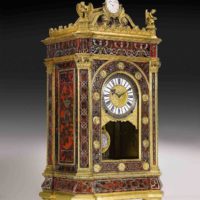
The only thing rarer than this magnificent Breguet Sympathique clock is how often we feature clocks on Click Tempus. This is a first, but what an exceptional first it is. What follows is a guide to the Duc d’ Orléans Breguet Sympathique clock and its illustrious history.
The Sotheby’s Important Watches & Clocks auction in New York on 4 December 2012 will have as its star attraction The Duc d’Orléans Breguet Sympathique, a distinguished example of the exceptionally rare Sympathique clocks that helped cement the fame and renown of French watchmaker Abraham-Louis Breguet.
No other horological invention has been as consistently associated with the palaces and grand houses of the European royalty and aristocracy as the Breguet Sympathiques.
The example on display, named The Duc d’Orléans after its patron and dated to 1835, has the most complex Sympathique mechanism of all known examples: it is the only one known to wind, set time and regulate its accompanying pocket watch, via the integrated cradle mounted onto the clock’s pediment.
This magnificent clock is further distinguished by having been in the celebrated Time Museum collection assembled by Seth Atwood, and its winding mechanism was restored by the 20th century’s most illustrious Horologist and watchmaker Dr. George Daniels, MBE, CBE.
The Duc d’Orléans carries an estimate in excess of $5 million, and will be on view in Sotheby’s York Avenue galleries beginning 1 December as part of the full Watches & Clocks viewing.
The Patron

Ferdinand-Philippe assumed the title of Duc d’Orléans in 1830, when his father Louis Philippe became King of France. The Duc was well educated, with a distinguished military career and a clear passion for the arts. He is said to have regularly spent more than a tenth of his annual million-Franc income on art and cultural patronage, collecting medieval works of art, Chinese porcelain, fine furniture, and modern paintings by artists such as Camille Corot and Theodore Rousseau.
The Commission
In commissioning his Sympathique, the Duc d’Orleans clearly wanted to combine the latest technology with a decorative design, sumptuously styled in a manner that would befit his apartments in the Pavillion de Marsan, part of the Louvre complex.
Abraham-Louis Breguet was exiled in Switzerland during the French Revolution, and there conceived the ingenious idea of the Sympathique. The clocks were primarily designed to demonstrate the quality and ability of his craft and to enhance his already distinguished reputation as the most innovative horologist of his time.
The complexity of the Sympathiques was such that construction could take years. Although the Duc d’Orléans’s clock is numbered as part of a series started ten years after Abraham-Louis Breguet’s death, the watch itself belongs to a series begun in 1794.
The Legacy
In 1974, American collector Seth G. Atwood approached master watchmaker and Breguet scholar Dr. George Daniels with a list of “must have” pieces – including a Sympathique for his Time Museum in Rockford Illinois.
Locating a Breguet Sympathique was not an easy request, given that all known examples were already in museums. Daniels managed to locate an example in Paris through a French antiques dealer, but the entire self-winding mechanism was missing. At this time in 1974, Daniels was the acknowledged expert of Breguet’s work, and thus Atwood was pleased to have Daniels restore the missing self-winding mechanism. Daniels went on to publish his book The Art of Breguet the following year.
Approximately 12 Sympathiques are known at this time. Of the existing clocks, three were made for the Spanish Crown, four for the Russian crown, one was commissioned by Napoleon as a state gift for the Turkish Sultan Mahmut II and one by the British King George IV. Of the entire group, eight are retained by National Museums. Only four have been offered at public auction, of which one is now in The Beyer Museum in Zurich.
The others, including the present piece, were purchased by private collectors. Of the known clocks, few have remained in their original state, some no longer possess their original watches, while others have been stripped of both the watch and its syncing connections to the Sympathique.
The Price
The Duc d’Orléans Breguet Sympathique was last offered at auction in Sotheby’s 1999 sale of Masterpieces from the Time Museum, where it achieved $5,777,500 – this price remains the auction record for any clock. It promises to be a most intriguing auction.