






Each year at Christmas we issue a Ghost Story. The first two were self penned, but this year, we have invited a long dead master of the genre to retell a spooky story on the high seas.
Born November 15th, 1877, William Hope Hodgson was the second of twelve children, three of whom would die in infancy. At the age of 13, he tried to run away and become a sailor, only to be caught and returned to his parents — where his father gave permission for Hodgson to be apprenticed as a cabin boy. Hodgson’s time at sea would influence his later career as a writer, and during his lifetime his stories of maritime adventure were what he was best known for. Many of these nautical yarns would be tinged with supernatural horror. His story follows. But here, more than anywhere, we appreciate that time is precious, so if you do not have time to read the story below, you can listen to it here while you work or wrap Christmas gifts.
IT WAS a dark, starless night. We were becalmed in the Northern
Pacific. Our exact position I do not know; for the sun had been
hidden during the course of a weary, breathless week, by a thin
haze which had seemed to float above us, about the height of our
mastheads, at whiles descending and shrouding the surrounding
sea.
With there being no wind, we had steadied the tiller, and I
was the only man on deck. The crew, consisting of two men and a
boy, were sleeping forrard in their den; while Will — my friend,
and the master of our little craft — was aft in his bunk on the
port side of the little cabin.
Suddenly, from out of the surrounding darkness, there came a
hail:
“Schooner, ahoy!”
The cry was so unexpected that I gave no immediate answer,
because of my surprise.
It came again — a voice curiously throaty and inhuman,
calling from somewhere upon the dark sea away on our port
broadside:
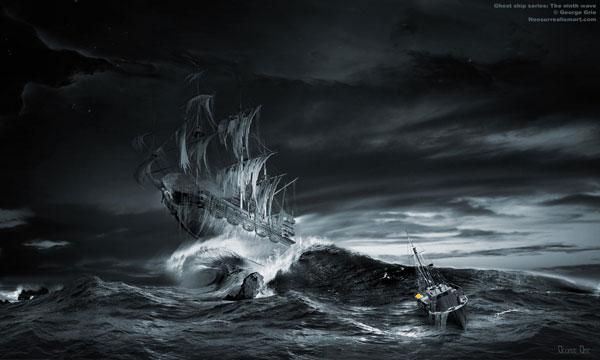
“Schooner, ahoy!”
“Hullo!” I sung out, having gathered my wits somewhat.
“What are you? What do you want?”
“You need not be afraid,” answered the voice, having
probably noticed some trace of confusion in my tone. “I am only
an old man.”
The pause sounded oddly; but it was only afterwards that it
came back to me with any significance.
“Why don’t you come alongside, then?” I queried somewhat
snappishly; for I liked not his hinting at my having been a
trifle shaken.
“I — I — can’t. It wouldn’t be safe. I ——” The voice broke
off, and there was silence.
“What do you mean?” I asked, growing more and more
astonished. “Why not safe? Where are you?”
I listened for a moment; but there came no answer. And then, a sudden indefinite suspicion, of I knew not what, coming to me, I stepped swiftly to the binnacle, and took out the lighted lamp.
At the same time, I knocked on the deck with my
heel to waken Will. Then I was back at the side, throwing the
yellow funnel of light out into the silent immensity beyond our
rail. As I did so, I heard a slight, muffled cry, and then the
sound of a splash as though someone had dipped oars abruptly.
Yet I cannot say that I saw anything with certainty; save, it
seemed to me, that with the first flash of the light, there had
been something upon the waters, where now there was nothing.
“Hullo, there!” I called. “What foolery is this!”
But there came only the indistinct sounds of a boat being
pulled away into the night.
Then I heard Will’s voice, from the direction of the after
scuttle:
“What’s up, George?”
“Come here, Will!” I said.
“What is it?” he asked, coming across the deck.
I told him the odd thing which had happened. He put
several questions; then, after a moment’s silence, he raised his
hands to his lips, and hailed:
“Boat, ahoy!”
From a long distance away there came back to us a faint
reply, and my companion repeated his call. Presently, after a
short period of silence, there grew on our hearing the muffled
sound of oars; at which Will hailed again.
This time there was a reply:
“Put away the light.”
“I’m damned if I will,” I muttered; but Will told me to do
as the voice bade, and I shoved it down under the bulwarks.
“Come nearer,” he said, and the oar-strokes continued. Then,
when apparently some half-dozen fathoms distant, they again
ceased.
“Come alongside,” exclaimed Will. “There’s nothing to be
frightened of aboard here!”
“Promise that you will not show the light?”
“What’s to do with you,” I burst out, “that you’re so
infernally afraid of the light?”
“Because ——” began the voice, and stopped short.
“Because what?” I asked quickly.
Will put his hand on my shoulder.
“Shut up a minute, old man,” he said, in a low voice. “Let
me tackle him.”
He leant more over the rail.
“See here, Mister,” he said, “this is a pretty strange
business, you coming upon us like this, right out in the middle
of the blessed Pacific. How are we to know what sort of a
hanky-panky trick you’re up to? You say there’s only one of you.
How are we to know, unless we get a squint at you — eh? What’s
your objection to the light, anyway?”
As he finished, I heard the noise of the oars again, and
then the voice came; but now from a greater distance, and
sounding extremely hopeless and pathetic.
“I am sorry — sorry! I would not have troubled you, only I
am hungry, and — so is she.”
The voice died away, and the sound of the oars, dipping
irregularly, was borne to us.
“Stop!” sung out Will. “I don’t want to drive you away.
Come back! We’ll keep the light hidden, if you don’t like it.”
He turned to me:
“It’s a damned odd rig, this; but I think there’s nothing
to be afraid of?”
There was a question in his tone, and I replied.
“No, I think the poor devil’s been wrecked around here, and
gone crazy.”
The sound of the oars drew nearer.
“Shove that lamp back in the binnacle,” said Will; then he
leaned over the rail and listened. I replaced the lamp, and came
back to his side. The dipping of the oars ceased some dozen
yards distant.
“Won’t you come alongside now?” asked Will in an even voice.
“I have had the lamp put back in the binnacle.”
“I — I cannot,” replied the voice. “I dare not come nearer.
I dare not even pay you for the — the provisions.”
“That’s all right,” said Will, and hesitated.
“You’re welcome to as much grub as you can take ——” Again he
hesitated.
“You are very good,” exclaimed the voice. “May God, Who
understands everything, reward you ——” It broke off huskily.
“The — the lady?” said Will abruptly. “Is she ——”
“I have left her behind upon the island,” came the voice.
“What island?” I cut in.
“I know not its name,” returned the voice. “I would
to God ——!” it began, and checked itself as suddenly.
“Could we not send a boat for her?” asked Will at this
point.
“No!” said the voice, with extraordinary emphasis. “My God!
No!” There was a moment’s pause; then it added, in a tone which
seemed a merited reproach:
“It was because of our want I ventured — because her agony
tortured me.”
“I am a forgetful brute,” exclaimed Will. “Just wait a
minute, whoever you are, and I will bring you up something at
once.”
In a couple of minutes he was back again, and his arms were
full of various edibles. He paused at the rail.
“Can’t you come alongside for them?” he asked.
“No — I DARE NOT,” replied the voice, and it seemed to me
that in its tones I detected a note of stifled craving — as though
the owner hushed a mortal desire. It came to me then in a flash,
that the poor old creature out there in the darkness, was
suffering for actual need of that which Will held in his arms;
and yet, because of some unintelligible dread, refraining from
dashing to the side of our little schooner, and receiving it.
And with the lightning-like conviction, there came the knowledge
that the Invisible was not mad; but sanely facing some
intolerable horror.
“Damn it, Will!” I said, full of many feelings, over which
predominated a vast sympathy. “Get a box. We must float off the
stuff to him in it.”
This we did — propelling it away from the vessel, out into
the darkness, by means of a boathook. In a minute, a slight cry
from the Invisible came to us, and we knew that he had secured
the box.
A little later, he called out a farewell to us, and so
heartful a blessing, that I am sure we were the better for it.
Then, without more ado, we heard the ply of oars across the
darkness.
“Pretty soon off,” remarked Will, with perhaps just a little
sense of injury.
“Wait,” I replied. “I think somehow he’ll come back. He
must have been badly needing that food.”
“And the lady,” said Will. For a moment he was silent;
then he continued:
“It’s the queerest thing ever I’ve tumbled across, since
I’ve been fishing.”
“Yes,” I said, and fell to pondering.
And so the time slipped away — an hour, another, and still
Will stayed with me; for the adventure had knocked all
desire for sleep out of him.
The third hour was three parts through, when we heard again
the sound of oars across the silent ocean.
“Listen!” said Will, a low note of excitement in his voice.
“He’s coming, just as I thought,” I muttered.
The dipping of the oars grew nearer, and I noted that the
strokes were firmer and longer. The food had been needed.
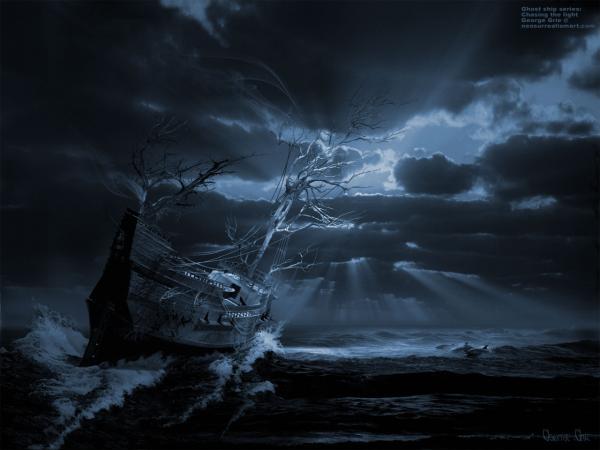
They came to a stop a little distance off the broadside, and
the ethereal voice came again to us through the darkness:
“Schooner, ahoy!”
“That you?” asked Will.
“Yes,” replied the voice. “I left you suddenly; but — but
there was great need.”
“The lady?” questioned Will.
“The — lady is grateful now on earth. She will be more
grateful soon in — in heaven.”
Will began to make some reply, in a puzzled voice; but
became confused, and broke off short. I said nothing. I was
wondering at the curious pauses, and, apart from my wonder, I was
full of a great sympathy.
The voice continued:
“We — she and I, have talked, as we shared the result of
God’s tenderness and yours ——”
Will interposed; but without coherence.
“I beg of you not to — to belittle your deed of Christian
charity this night,” said the voice. “Be sure that it has not
escaped His notice.”
It stopped, and there was a full minute’s silence. Then it
came again:
“We have spoken together upon that which — which has befallen
us. We had thought to go out, without telling any, of the terror
which has come into our — lives. She is with me in believing that
to-night’s happenings are under a special ruling, and that it is
God’s wish that we should tell to you all that we have suffered
since — since ——”
“Yes?” said Will softly.
“Since the sinking of the Albatross.”
“Ah!” I exclaimed involuntarily. “She left Newcastle for
‘Frisco some six months ago, and hasn’t been heard of since.”
“Yes,” answered the voice. “But some few degrees to the
North of the line she was caught in a terrible storm, and
dismasted. When the day came, it was found that she was leaking
badly, and, presently, it falling to a calm, the sailors took to
the boats, leaving — leaving a young lady — my fiancée — and myself
upon the wreck.
“We were below, gathering together a few of our belongings,
when they left. They were entirely callous, through fear, and
when we came up upon the deck, we saw them only as small shapes
afar off upon the horizon. Yet we did not despair, but set to
work and constructed a small raft. Upon this we put such few
matters as it would hold including a quantity of water and some
ship’s biscuit. Then, the vessel being very deep in the water,
we got ourselves on to the raft, and pushed off.
“It was later, when I observed that we seemed to be in the
way of some tide or current, which bore us from the ship at an
angle; so that in the course of three hours, by my watch, her
hull became invisible to our sight, her broken masts remaining in
view for a somewhat longer period. Then, towards evening, it
grew misty, and so through the night. The next day we were still
encompassed by the mist, the weather remaining quiet.
“For four days we drifted through this strange haze, until,
on the evening of the fourth day, there grew upon our ears the
murmur of breakers at a distance. Gradually it became plainer,
and, somewhat after midnight, it appeared to sound upon either
hand at no very great space. The raft was raised upon a swell
several times, and then we were in smooth water, and the noise of
the breakers was behind.
“When the morning came, we found that we were in a sort of
great lagoon; but of this we noticed little at the time; for
close before us, through the enshrouding mist, loomed the hull of
a large sailing-vessel. With one accord, we fell upon our knees
and thanked God; for we thought that here was an end to our
perils. We had much to learn.
“The raft drew near to the ship, and we shouted on them to
take us aboard; but none answered. Presently the raft touched
against the side of the vessel, and, seeing a rope hanging
downwards, I seized it and began to climb. Yet I had much ado to
make my way up, because of a kind of grey, lichenous fungus which
had seized upon the rope, and which blotched the side of the ship
lividly.
“I reached the rail and clambered over it, on to the deck.
Here I saw that the decks were covered, in great patches, with
grey masses, some of them rising into nodules several feet in
height; but at the time I thought less of this matter than of
the possibility of there being people aboard the ship. I
shouted; but none answered. Then I went to the door below the
poop deck. I opened it, and peered in. There was a great smell
of staleness, so that I knew in a moment that nothing living
was within, and with the knowledge, I shut the door quickly; for
I felt suddenly lonely.
“I went back to the side where I had scrambled up. My
sweetheart was still sitting quietly upon the raft. Seeing me
look down she called up to know whether there were any aboard of
the ship. I replied that the vessel had the appearance of having
been long deserted; but that if she would wait a little I would
see whether there was anything in the shape of a ladder by which
she could ascend to the deck. Then we would make a search
through the vessel together. A little later, on the opposite
side of the decks, I found a rope side-ladder. This I carried
across, and a minute afterwards she was beside me.
“Together we explored the cabins and apartments in the after part of the ship; but nowhere was there any sign of life. Here and there within the cabins themselves, we came across odd patches of that strange fungus; but this, as my sweetheart said, could be cleansed away.
“In the end, having assured ourselves that the after portion
of the vessel was empty, we picked our ways to the bows, between
the ugly grey nodules of that strange growth; and here we made a
further search which told us that there was indeed none aboard
but ourselves.
“This being now beyond any doubt, we returned to the stern
of the ship and proceeded to make ourselves as comfortable as
possible. Together we cleared out and cleaned two of the cabins:
and after that I made examination whether there was anything
eatable in the ship. This I soon found was so, and thanked God
in my heart for His goodness. In addition to this I discovered
the whereabouts of the fresh-water pump, and having fixed it I
found the water drinkable, though somewhat unpleasant to the
taste.
“For several days we stayed aboard the ship, without
attempting to get to the shore. We were busily engaged in making
the place habitable. Yet even thus early we became aware that
our lot was even less to be desired than might have been
imagined; for though, as a first step, we scraped away the odd
patches of growth that studded the floors and walls of the cabins
and saloon, yet they returned almost to their original size
within the space of twenty-four hours, which not only discouraged
us, but gave us a feeling of vague unease.
“Still we would not admit ourselves beaten, so set to work
afresh, and not only scraped away the fungus, but soaked the
places where it had been, with carbolic, a can-full of which I
had found in the pantry. Yet, by the end of the week the growth
had returned in full strength, and, in addition, it had spread to
other places, as though our touching it had allowed germs from it
to travel elsewhere.
“On the seventh morning, my sweetheart woke to find a small
patch of it growing on her pillow, close to her face. At that,
she came to me, so soon as she could get her garments upon her.
I was in the galley at the time lighting the fire for breakfast.
“Come here, John,” she said, and led me aft. When
I saw the thing upon her pillow I shuddered, and then and there
we agreed to go right out of the ship and see whether we could
not fare to make ourselves more comfortable ashore.
“Hurriedly we gathered together our few belongings, and even
among these I found that the fungus had been at work; for one
of her shawls had a little lump of it growing near one edge. I
threw the whole thing over the side, without saying anything to
her.
“The raft was still alongside, but it was too clumsy to
guide, and I lowered down a small boat that hung across the
stern, and in this we made our way to the shore. Yet, as we drew
near to it, I became gradually aware that here the vile fungus,
which had driven us from the ship, was growing riot. In places
it rose into horrible, fantastic mounds, which seemed almost to
quiver, as with a quiet life, when the wind blew across them.
Here and there it took on the forms of vast fingers, and in
others it just spread out flat and smooth and treacherous. Odd
places, it appeared as grotesque stunted trees, seeming
extraordinarily kinked and gnarled — the whole quaking vilely at
times.
“At first, it seemed to us that there was no single portion
of the surrounding shore which was not hidden beneath the masses
of the hideous lichen; yet, in this, I found we were mistaken;
for somewhat later, coasting along the shore at a little
distance, we descried a smooth white patch of what appeared to be
fine sand, and there we landed. It was not sand. What it was I
do not know. All that I have observed is that upon it the fungus
will not grow; while everywhere else, save where the sand-like
earth wanders oddly, path-wise, amid the grey desolation of the
lichen, there is nothing but that loathsome greyness.
“It is difficult to make you understand how cheered we were
to find one place that was absolutely free from the growth, and
here we deposited our belongings. Then we went back to the ship
for such things as it seemed to us we should need. Among other
matters, I managed to bring ashore with me one of the ship’s
sails, with which I constructed two small tents, which, though
exceedingly rough-shaped, served the purpose for which they were
intended. In these we lived and stored our various necessities,
and thus for a matter of some four weeks all went smoothly and
without particular unhappiness. Indeed, I may say with much of
happiness — for — for we were together.
“It was on the thumb of her right hand that the growth first showed. It was only a small circular spot, much like a little grey mole. My God! how the fear leapt to my heart when she showed me the place.
We cleansed it, between us, washing it with
carbolic and water. In the morning of the following day she
showed her hand to me again. The grey warty thing had returned.
For a little while, we looked at one another in silence. Then,
still wordless, we started again to remove it. In the midst of
the operation she spoke suddenly.
“‘What’s that on the side of your face, dear?’ Her voice
was sharp with anxiety. I put my hand up to feel.
“‘There! Under the hair by your ear. A little to the front
a bit.’ My finger rested upon the place, and then I knew.
“‘Let us get your thumb done first,’ I said. And she
submitted, only because she was afraid to touch me until it was
cleansed. I finished washing and disinfecting her thumb, and
then she turned to my face. After it was finished we sat
together and talked awhile of many things for there had come into
our lives sudden, very terrible thoughts. We were, all at once,
afraid of something worse than death. We spoke of loading the
boat with provisions and water and making our way out on to the
sea; yet we were helpless, for many causes, and — and the growth
had attacked us already. We decided to stay. God would do with
us what was His will. We would wait.
“A month, two months, three months passed and the places
grew somewhat, and there had come others. Yet we fought so
strenuously with the fear that its headway was but slow,
comparatively speaking.
“Occasionally we ventured off to the ship for such stores as
we needed. There we found that the fungus grew persistently.
One of the nodules on the maindeck became soon as high as my
head.
“We had now given up all thought or hope of leaving the
island. We had realized that it would be unallowable to go among
healthy humans, with the things from which we were suffering.
“With this determination and knowledge in our minds we knew
that we should have to husband our food and water; for we did
not know, at that time, but that we should possibly live for many
years.
“This reminds me that I have told you that I am an old man.
Judged by the years this is not so. But — but ——”
He broke off; then continued somewhat abruptly:
“As I was saying, we knew that we should have to use care in
the matter of food. But we had no idea then how little food
there was left of which to take care. It was a week later that I
made the discovery that all the other bread tanks — which I had
supposed full — were empty, and that (beyond odd tins of
vegetables and meat, and some other matters) we had nothing on
which to depend, but the bread in the tank which I had already
opened.
“After learning this I bestirred myself to do what I could,
and set to work at fishing in the lagoon; but with no success.
At this I was somewhat inclined to feel desperate until the
thought came to me to try outside the lagoon, in the open sea.
“Here, at times, I caught odd fish; but so infrequently that
they proved of but little help in keeping us from the hunger
which threatened.
It seemed to me that our deaths were likely to come by
hunger, and not by the growth of the thing which had seized upon
our bodies.
“We were in this state of mind when the fourth month wore
out. When I made a very horrible discovery. One morning, a
little before midday. I came off from the ship with a portion of
the biscuits which were left. In the mouth of her tent I saw my
sweetheart sitting, eating something.
“‘What is it, my dear?’ I called out as I leapt ashore.
Yet, on hearing my voice, she seemed confused, and, turning,
slyly threw something towards the edge of the little clearing.
It fell short, and a vague suspicion having arisen within me, I
walked across and picked it up. It was a piece of the grey fungus.
“As I went to her with it in my hand, she turned deadly pale;
then rose red.
“I felt strangely dazed and frightened.
“‘My dear! My dear!’ I said, and could say no more. Yet at
words she broke down and cried bitterly. Gradually, as she calmed,
I got from her the news that she had tried it the preceding day,
and — and liked it. I got her to promise on her knees not to touch
it again, however great our hunger. After she had promised she
told me that the desire for it had come suddenly, and that, until
the moment of desire, she had experienced nothing towards it but
the most extreme repulsion.
“Later in the day, feeling strangely restless, and much shaken
with the thing which I had discovered, I made my way along one of
the twisted paths — formed by the white, sand-like substance — which
led among the fungoid growth. I had, once before, ventured along
there; but not to any great distance. This time, being involved
in perplexing thought, I went much further than hitherto.
“Suddenly I was called to myself by a strange hoarse sound on my left. Turning quickly I saw that there was movement among an extraordinarily shaped mass of fungus, close to my elbow. It was swaying uneasily, as though it possessed life of its own.
Abruptly, as I stared, the thought came to me that the thing had a
grotesque resemblance to the figure of a distorted human creature.
Even as the fancy flashed into my brain, there was a slight,
sickening noise of tearing, and I saw that one of the branch-like
arms was detaching itself from the surrounding grey masses, and
coming towards me. The head of the thing — a shapeless grey ball,
inclined in my direction. I stood stupidly, and the vile arm
brushed across my face. I gave out a frightened cry, and ran back
a few paces. There was a sweetish taste upon my lips where the
thing had touched me. I licked them, and was immediately filled
with an inhuman desire. I turned and seized a mass of the fungus.
Then more and — more. I was insatiable. In the midst of devouring,
the remembrance of the morning’s discovery swept into my mazed
brain. It was sent by God. I dashed the fragment I held to the
ground. Then, utterly wretched and feeling a dreadful guiltiness,
I made my way back to the little encampment.
“I think she knew, by some marvellous intuition which love
must have given, so soon as she set eyes on me. Her quiet sympathy
made it easier for me, and I told her of my sudden weakness; yet
omitted to mention the extraordinary thing which had gone before.
I desired to spare her all unnecessary terror.
“But, for myself, I had added an intolerable knowledge, to
breed an incessant terror in my brain; for I doubted not but that
I had seen the end of one of those men who had come to the island
in the ship in the lagoon; and in that monstrous ending I had seen
our own.
“Thereafter we kept from the abominable food, though the
desire for it had entered into our blood. Yet our drear punishment
was upon us; for, day by day, with monstrous rapidity, the fungoid
growth took hold of our poor bodies. Nothing we could do would
check it materially, and so — and so — we who had been human, became
—— Well, it matters less each day. Only — only we had been man and
maid!
“And day by day the fight is more dreadful, to withstand the
hungerlust for the terrible lichen.
“A week ago we ate the last of the biscuit, and since that
time I have caught three fish. I was out here fishing tonight when
your schooner drifted upon me out of the mist. I hailed you. You
know the rest, and may God, out of His great heart, bless you for
your goodness to a — a couple of poor outcast souls.”
There was the dip of an oar — another. Then the voice came
again, and for the last time, sounding through the slight
surrounding mist, ghostly and mournful.
“God bless you! Good-bye!”
“Good-bye,” we shouted together, hoarsely, our hearts full of
many emotions.
I glanced about me. I became aware that the dawn was upon us.
The sun flung a stray beam across the hidden sea; pierced the
mist dully, and lit up the receding boat with a gloomy fire.
Indistinctly I saw something nodding between the oars. I thought
of a sponge — a great, grey nodding sponge — The oars continued to
ply. They were grey — as was the boat — and my eyes searched a
moment vainly for the conjunction of hand and oar. My gaze flashed
back to the — head. It nodded forward as the oars went backward for
the stroke. Then the oars were dipped, the boat shot out of the
patch of light, and the — the thing went nodding into the mist.