






Unless you’re an avid horologist or you have a job on the Battlestar Galactica you might not be aware that magnetic fields and watch movements don’t really mix. Think of it as the watch equivalent of putting a tube of Mentos into a bottle of Diet Coke. In fact, a mechanical watch will pretty much grind to a halt if it is exposed to a strong enough magnetic field, and in the most extreme case it could even come clean off your wrist!
This is the reason why the digital watch is the watch of choice for MRI technicians and CERN scientists. However, following the announcement from Omega that it is to a release a new anti-magnetic movement, lab techs and science bods may finally have a much more stylish option for their next timepiece.

At a press conference held on January 17th at Cite du Temps in Geneva, Omega showcased a new anti-magnetic watch movement, which provides resistance greater than 1.5 tesla (15,000 gauss) when exposed to magnetic fields. A gauss is the unit of magnetic induction. To put it into perspective, 15,000 gauss is about twice the level of magnetic output from your average sub-woofer, whereas an MRI can hit in excess of 70,000 gauss, at its peak.
Anti-magnetic watches have been around for the best part of 50 years or more, with the Rolex Milgauss perhaps being the most well known. Interestingly, this watch was originally developed for the scientists of CERN who were often exposed to powerful magnetic forces during their work. The magnetic forces would then render the scientists mechanical watch movement all but useless. Rolex solved this problem by housing the watch’s movement in a non-ferrous metal cage. However, the Milgauss can only withstand magnetic output of up 1000 gauss.
With the new prototype movement, the 8508, Omega have brought anti-magnetic watches right up to speed, and after including it in their new Seamaster Aqua Terra, the Rolex Milgauss now looks a little dated. Unlike the Rolex Milgauss, the Omega movement does not rely on a non-ferrous cage, instead the movement itself is made from a selection of non-ferrous metals.
Looking at the watch itself, it’s a cool, if not fairly standard Omega design but it’s obviously the new movement that makes it special.
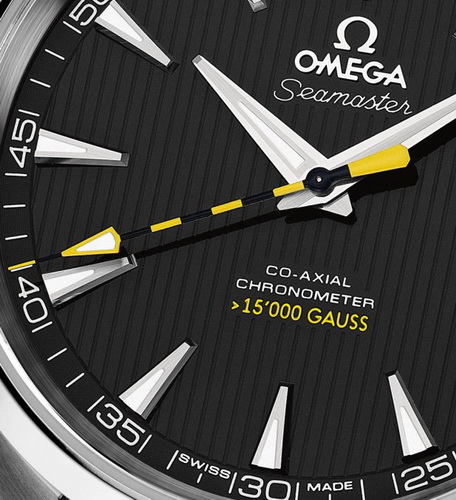
Despite several patents still pending on the 8508 movement, Omega plan to fully present the new technology at Baselworld 2013, before it is launched on the commercial market later in the year. Whilst its retail price is yet to be officially confirmed, it is thought to be somewhere in the region of around $10,000.
Some might think that this is a little on the pricey side. However, it could be money well spent should you happen to unexpectedly stumble upon a magnetic time vortex during your Sunday afternoon stroll in the park.
Keep up to date with the latest from Click Tempus on Facebook and Google+