






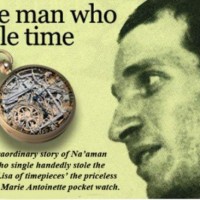
For more than 20 years ‘The Queen’ rested in a cardboard box, shrouded in an old newspaper. This was the fate of one of the costliest pocket watches in the world, a brilliant masterpiece by the clockmaker Louis Breguet that was completed in 1827, a full 44 years after it was commissioned for Queen Marie Antoinette. It disappeared from public view in a burglary that took place on April 15, 1983, after many years of having been on display at the small LA Mayer Museum for Islamic Art in Jerusalem. There it formed part of a collection of 106 antique timepieces, among them the ‘Sympathiques’ clock – another Breguet masterpiece – and a pistol-shaped clock made by the Rochat Brothers.
At the time of the heist I was living in an apartment with a low window that overlooked the concealed path along which the loot was spirited away. But I didn’t hear a thing; the robbery took place in silence at an hour when the world was asleep. So it was that Jerusalem and the world lost for about 25 years the timepieces from the exquisite collection donated to the museum by Vera, daughter of Sir David Lionel Salomons, a magistrate, politician and banker in England.
The Israeli police have since revealed that a man robbed the museum single-handedly.
When as a young reporter I began to investigate the incident, the prevailing assumption was that a gang of three or four had penetrated through the rear entrance and worked through the night despite the presence in the museum of two guards: the amount of tools, food and bottles left behind suggested the involvement of at least a three-strong gang. It was presumed that the swag had fallen into the hands of some solitary billionaire who was privately enjoying the beauty of the stolen goods and the charms of the French queen – a queen reckoned to be worth about $30m, yet unmarketable on the open market because of its fame. The value of the collection made the robbery one of the largest in history, and for more than 20 years the authorities searched, investigated and waited.
25 years after the burglary the Israeli police permitted publication of the fact that a man who 40 years ago had become a criminal legend in Israel had committed the daring robbery single-handedly. Na’aman Diller has been dead for four years now, but the revelation that the former kibbutznik was the thief links two amazing stories from the annals of Israeli crime.
Diller was one of my childhood heroes – if the son of a teacher can adopt a criminal as a hero, as a kind of rebellion against respectability. In the 1960s Diller, a very gaunt and silent man, was an extraordinary bank robber in a young and socialist country where banks were seen as a necessary evil.
In the spring of 1967 Diller began to dig his way to the safe of a bank two streets from my home in Tel Aviv. Dressed in a postal worker’s overall, he dug through backyards, excavating a ditch from his van towards the bank. He was a one-man gang, both the brain and the burglar. From a visit to England, he had brought back break-in tools and a book about welding that included in it a method for cracking steel.
Patiently, he laid copper tubing through the yards to carry soldering gas. The Six Day War short-circuited his plan. Diller covered up his excavation and joined the fighters. When he returned from the war he immediately went back to the bank. Half a year after he had begun to act, he cut through the strong-room door, slipped through it and reached the treasure. He felt, as he said later, “that thrill a man feels at the side of a beautiful woman when he knows that suddenly she is his.”
He gathered up 97,000 Israeli pounds, $8,000 in American notes, diamonds and jewellery – a haul worth a quarter of a million Israeli pounds. This was a huge take, at a time when the first prize in the National Lottery was 100,000 pounds. Alas for him, neighbours had heard the noise he’d made and had called the police: Diller was caught just as his robbery had reached its triumphal climax. He was tried, and imprisoned for 4 years. Let out, he burgled again and was jailed once more. He was finally released in 1982 – whereupon he disappeared.
A lone wolf, Diller almost became an air force pilot but was thrown out of the service because he took an airplane and flew over his kibbutz. It was a savage blow, and he remained bitter, seeking vengeance, crime and, apparently, punishment – after every burglary he was caught, seemingly of his own volition. Until, that is, the spring of 1983, when he carried out the greatest of his capers. According to police, Diller used a crowbar to bend the bars on a back window of the museum and, behind the cover of a parked lorry, climbed inside with a ladder. Having staked out the museum, he knew the alarm was broken and the guard was stationed in front.
During the years after the robbery, as a seemingly reformed citizen he frequently flew to Europe, where he disposed of a few of the timepieces. Others, among them the Queen’s watch, he kept in safes, in storehouses and in his apartment. In 2004 on his deathbed, Diller confessed to his wife, Nili Shamrat, that he had stolen the Breguet collection. Only when the woman tried to sell the timepieces to a watchmaker in August 2006, was the mystery finally solved.
In November 2008 it was announced that another 43 of the missing clocks had been found in safes in France. Now only 10 remain to be found.
In January, 2009, an exhibition of about half of the timepieces that have been returned to the museum will open to the public. At its dazzling heart will be the ‘Mona Lisa of timepieces’, as the precious pocket watch has been called – a kind of miniature mechanical computer made of gold and crystal that sets itself, commissioned for a Queen who was beheaded before the priceless timepiece was completed.
~ by Igal Sarna